How Many Gallons of Paint for Kitchen Cabinets? Formula & Sizing Guide
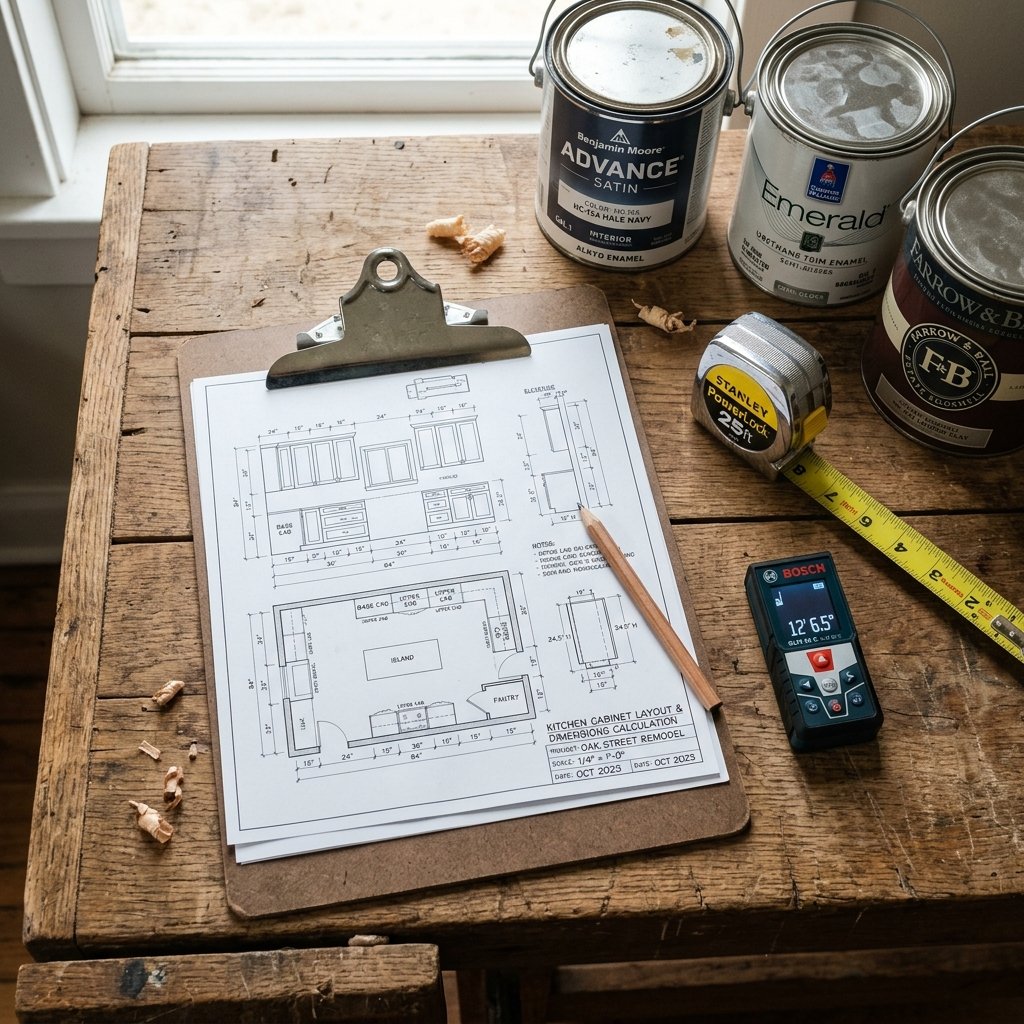
QUICK ANSWER & SIZING BENCHMARK
Determining how many gallons of paint for kitchen cabinets depends on your door count, total surface area, and application method. For standard two-coat enamel coverage plus one coat of bonding primer:
- Small Kitchen (10–15 doors / ~10–15 linear ft): 1 gallon of primer + 1 to 2 gallons of enamel topcoat (or 1 gallon topcoat if rolling exterior faces only).
- Medium Kitchen (20–30 doors / ~16–25 linear ft): 1 to 2 gallons of primer + 2 gallons of enamel topcoat for full two-coat exterior coverage.
- Large Kitchen (35–50 doors / ~26–40+ linear ft): 2 to 3 gallons of primer + 3 to 4 gallons of enamel topcoat (especially when spraying with an HVLP or airless rig).
Key estimation rules before purchasing:
- The 2.2x Door Multiplier: Multiply single-face door area by 2.2 to accurately account for front faces, back faces, and edge profile relief.
- Transfer Efficiency Dictates Volume: Rolling achieves 85%–90% transfer efficiency, while HVLP spraying yields 60%–70% and airless spraying drops to 50%–60% due to overspray.
- Never Buy Multiple Quarts: Two retail quarts cost 70%–85% of a full gallon while risking color batch mismatches; always round up to full gallons.
- Two Thin Coats are Non-Negotiable: Spreading paint too thick to save a coat traps solvent, causing sagging, wrinkling, and weeks of soft film blocking.

ON THIS PAGE
- Kitchen cabinet paint sizing chart
- The 2.2x surface area calculation formula
- Step-by-step mathematical example (25-door kitchen)
- Spreading rate physics: theoretical vs. actual transfer efficiency
- Substrate absorption & porosity adjustments
- 5-step field sizing protocol & waste allowances
- Purchasing strategy: gallons vs. quarts & the boxing rule
- Frequently asked questions
Kitchen cabinet paint sizing chart: linear feet, door counts & gallon requirements
When calculating how many gallons of paint for kitchen cabinets, professional estimators evaluate total paintable square footage across five components: door fronts and backs, drawer fronts, face frame stiles and rails, exposed end gables, and interior shelving. The table below outlines real-world material benchmarks for standard residential kitchens using premium architectural enamels like Benjamin Moore Advance or Sherwin-Williams Emerald Urethane over a dedicated bonding primer.
| Kitchen Scale | Linear Footage | Door & Drawer Count | Total Paintable Area (1 Coat) | Primer Needed (1 Coat) | Enamel Topcoat (2 Coats – Brush/Roll) | Enamel Topcoat (2 Coats – HVLP/Airless) | Recommended Purchase Quantity |
|---|---|---|---|---|---|---|---|
| Small / Galley | 10 – 15 lin ft | 10–14 doors 4–6 drawers |
120 – 160 sq ft | 0.4 – 0.5 gal | 0.8 – 1.1 gal | 1.2 – 1.6 gal | 1 Gal Primer + 2 Gal Enamel |
| Medium / Standard | 16 – 25 lin ft | 18–28 doors 6–10 drawers |
220 – 320 sq ft | 0.7 – 1.0 gal | 1.4 – 2.1 gal | 2.1 – 2.8 gal | 1–2 Gal Primer + 2 Gal Enamel (Roll) 2 Gal Primer + 3 Gal Enamel (Spray) |
| Large / Open Concept | 26 – 35 lin ft | 30–42 doors 10–16 drawers |
350 – 480 sq ft | 1.1 – 1.5 gal | 2.3 – 3.1 gal | 3.3 – 4.4 gal | 2 Gal Primer + 3–4 Gal Enamel |
| Extra Large / Custom + Island | 36 – 50+ lin ft | 45–60+ doors 16–24 drawers |
520 – 750+ sq ft | 1.6 – 2.3 gal | 3.4 – 4.8 gal | 4.9 – 6.8 gal | 2–3 Gal Primer + 4–5 Gal Enamel |
*Note: Figures assume standard 30-inch to 42-inch upper cabinet heights, exterior door/frame painting, and standard profile profiles. If painting the interior box carcases and shelving, increase total paint requirements by 80%–120%.
The 2.2x surface area calculation formula for kitchen cabinets
The most common estimating mistake homeowners and novice painters make is measuring cabinet doors as flat two-dimensional rectangles. A standard cabinet door possesses six distinct coated surfaces: the front face, the rear face, two vertical side edges, and top/bottom end-grain edges. Furthermore, recessed panel (Shaker) and raised-panel profiles contain detailed bevels, lips, and routed channels that increase actual coated surface area by 15% to 25% over a flat slab.
To eliminate estimating error, coatings engineers utilize the 2.2x Profile Multiplier Formula:
MASTER CABINET SURFACE AREA EQUATION
Total Square Footage = (Door Area × 2.2) + (Drawer Front Area × 1.2) + Face Frame Area + End Panels + Island/Trim Extras
- Door Area × 2.2: Nominal single-face door area multiplied by 2.0 (front + back faces) + 0.20 (profile bevels, routing relief, and outer edge perimeter).
- Drawer Front Area × 1.2: Nominal front face area multiplied by 1.0 (face) + 0.20 (top, bottom, and side edges; drawer backs and interior boxes are rarely coated).
- Face Frame Area: Total linear run of cabinet carcases multiplied by frame height multiplied by 0.25 (face frame rails and stiles occupy ~25% of the total cabinet box frontal plane).
- Exposed End Panels (Gables): Height × Depth for every exposed cabinet box end (typically 12″ depth for uppers, 24″ depth for base cabinets).
Step-by-step mathematical example: calculating paint for a 25-door kitchen
Let us walk through an exact mathematical calculation for a typical suburban kitchen featuring 25 Shaker-style cabinet doors, 8 drawer fronts, and 20 linear feet of base and upper cabinets with 4 exposed end panels.
1. Cabinet Doors Calculation
Assume an average door dimension of 15 inches wide by 30 inches tall:
- Single door nominal face area: (15 in × 30 in) / 144 sq in = 3.125 sq ft
- Applying the 2.2x profile factor: 3.125 sq ft × 2.2 = 6.875 sq ft per door (both sides + profile edges)
- Total door surface area (25 doors): 25 × 6.875 sq ft = 171.88 sq ft
2. Drawer Fronts Calculation
Assume an average drawer front dimension of 15 inches wide by 7 inches tall:
- Single drawer nominal face area: (15 in × 7 in) / 144 sq in = 0.729 sq ft
- Applying the 1.2x edge factor: 0.729 sq ft × 1.2 = 0.875 sq ft per drawer
- Total drawer surface area (8 drawers): 8 × 0.875 sq ft = 7.00 sq ft
3. Face Frame Stiles and Rails
For 20 linear feet of 30-inch upper cabinets and 20 linear feet of 34.5-inch base cabinets:
- Upper frontal plane: 20 ft × 2.5 ft = 50 sq ft × 0.25 (frame ratio) = 12.50 sq ft
- Base frontal plane: 20 ft × 2.875 ft = 57.5 sq ft × 0.25 (frame ratio) = 14.38 sq ft
- Total face frame surface area: 12.50 + 14.38 = 26.88 sq ft
4. Exposed End Gables
- 2 Upper End Panels (12 in × 30 in): 2 × ((12 × 30) / 144) = 5.00 sq ft
- 2 Base End Panels (24 in × 34.5 in): 2 × ((24 × 34.5) / 144) = 11.50 sq ft
- Total end panel surface area: 5.00 + 11.50 = 16.50 sq ft
5. Total Surface Area & Gallon Conversion
- Total One-Coat Surface Area: 171.88 (doors) + 7.00 (drawers) + 26.88 (frames) + 16.50 (ends) = 222.26 sq ft
- Primer Requirement (1 Full Coat @ 350 sq ft/gal theoretical, 85% rolling efficiency = 297.5 practical sq ft/gal): 222.26 / 297.5 = 0.75 gallons → Purchase 1 Gallon of Bonding Primer.
- Enamel Topcoat Requirement (2 Full Coats = 444.52 sq ft): 444.52 / 297.5 = 1.49 gallons → Purchase 2 Gallons of Cabinet Enamel.
If you were spraying this exact kitchen with an airless sprayer (55% transfer efficiency = 192.5 practical sq ft/gal), your enamel requirement would be: 444.52 / 192.5 = 2.31 gallons → Purchase 3 Gallons of Cabinet Enamel.
Spreading rate physics: theoretical coverage vs. actual transfer efficiency
Paint manufacturers print a theoretical spreading rate on their Technical Data Sheets (TDS)—typically 350 to 400 square feet per gallon. This theoretical benchmark is derived from a flat drawdown blade on an impenetrable steel chart at a specified Wet Film Thickness (WFT). In residential cabinet refinishing, actual spreading rates are governed by Volume Solids (%) and the Transfer Efficiency (TE) of your application tool.
1. Volume Solids and Film Thickness Physics
A gallon of paint contains volatile carriers (water or solvent) and non-volatile solids (resins, pigments, and functional additives). When the paint dries, the volatile solvents evaporate, leaving behind the Dry Film Thickness (DFT). The relationship is governed by fundamental coatings physics:
DFT (mils) = WFT (mils) × (Volume Solids % / 100)
Premium cabinet enamels like Sherwin-Williams Emerald Urethane feature approximately 38% to 42% volume solids. To achieve the manufacturer-mandated dry film build of 1.5 mils per coat for maximum chip and scrub resistance, the applicator must apply a wet film of 3.8 to 4.0 mils. Spreading 1 gallon across more than 400 square feet results in an under-built, fragile film that fails premature scratch and blocking tests.
2. Transfer Efficiency by Application Method
Not all paint that leaves the can reaches the cabinet surface. The table below illustrates transfer efficiencies across application methods and how they directly modify the effective square footage per gallon:
| Application Method | Transfer Efficiency (%) | Overspray / Tool Loss (%) | Nominal Spread Rate | Real-World Spread Rate | Gallon Multiplier Factor |
|---|---|---|---|---|---|
| Brush & Mini-Roller (Microfiber / Foam 3/16″ nap) |
85% – 90% | 10% – 15% (Tray, roller nap loading, rim loss) |
350 – 400 sq ft/gal | 300 – 340 sq ft/gal | 1.15× |
| HVLP Turbine Sprayer (Fine Finish tip #3 / #4) |
65% – 75% | 25% – 35% (Air atomization bounce, exhaust) |
350 – 400 sq ft/gal | 230 – 280 sq ft/gal | 1.40× |
| Airless Sprayer (FFLP 210 / 310 Fine Finish Tip) |
50% – 60% | 40% – 50% (Hydraulic atomization, fluid line purge) |
350 – 400 sq ft/gal | 175 – 220 sq ft/gal | 1.75× |
When spraying cabinets, you must also account for the paint trapped inside fluid hoses. A standard 50-foot, 1/4-inch airless fluid line retains approximately 1 quart (0.25 gallons) of material before paint even exits the spray gun nozzle. For this reason, professional painters never attempt an airless spray setup with less than 2 gallons of material in the reservoir bucket.
Substrate absorption & porosity adjustments
The substrate beneath the coating directly impacts primer consumption on the first coat. Once a sealed, non-porous foundation is established by the primer, topcoat enamel spreading rates stabilize across all substrates. However, initial primer calculations must be adjusted according to substrate porosity:
- Open-Grain Hardwoods (Red Oak, White Oak, Ash): The deep annular vascular rings in oak act as capillary sponges, absorbing up to 20% more primer on the initial coat. When painting oak cabinets white, plan for an extra quart of high-solids primer (such as Zinsser BIN or Cover Stain) to fill grain pores.
- Porous MDF & Routed Edge Cores: Medium-density fiberboard (MDF) panels are dense on their pressed faces but exceptionally porous on routed edges and profiles. Exposed MDF end fibers consume primer rapidly; budget a 15% primer increase for heavy Shaker or beadboard profiles.
- Closed-Grain Woods (Maple, Birch, Cherry, Poplar): Tight, uniform cellular structures absorb minimal primer. Standard coverage rates (350 sq ft/gal) apply directly.
- Pre-Finished Factory Lacquers, Melamine & Laminate: Completely non-porous surfaces consume the least volume of primer per square foot. However, they require chemical bonding primers like INSL-X Stix applied in thin, uniform films (3.0 mils WFT) to prevent adhesion shearing.
5-step field sizing protocol & waste allowances
Follow this exact 5-step sizing protocol to calculate your paint order before visiting the paint retailer:
- Inventory & Categorize Components: Count all doors, drawer fronts, exposed cabinet ends, and calculate total linear feet of base and upper cabinet frames. Check if crown molding, light rails, or a center kitchen island are included in the scope.
- Compute Net Surface Area: Apply the 2.2x multiplier to total door area and 1.2x to drawer fronts. Add face frames (Linear ft × Height × 0.25) and exposed end panels to establish total single-coat square footage.
- Define Coating Layers: Standard specifications require 1 full coat of dedicated bonding/stain-blocking primer followed by 2 full coats of cabinet-grade enamel. If transitioning from dark espresso stain to pure white, add a second coat of high-hiding primer.
- Apply Application Method Waste Allowance:
- Brushing & Rolling: Add 15% waste contingency.
- HVLP Turbine Spraying: Add 35% waste contingency.
- Airless Spraying: Add 50% waste contingency + 1 quart for fluid line charging.
- Convert to Container Units & Round Up: Divide total adjusted square footage by 350 sq ft/gal. Always round upward to the nearest full gallon or quart to prevent stopping mid-project.
Purchasing strategy: gallons vs. quarts & the boxing rule
When your calculations indicate an odd quantity—such as 1.4 gallons or 2.3 gallons—homeowners often debate whether to purchase individual quarts or full gallons. Understanding paint retail economics and color science provides a clear answer.
The Retail Price Trap of Quarts
Architectural coatings manufacturers price quart containers at an extreme premium per fluid ounce. In premium cabinet enamel lines (such as Benjamin Moore Advance or Sherwin-Williams Emerald Urethane), a single quart retails for $32 to $42, while a full gallon retails for $85 to $105. Purchasing two individual quarts ($64–$84) costs nearly as much as a whole gallon, yet yields half the volume.
The “Boxing” Rule for Uniform Sheen and Color
Automated paint tinting carousels at retail paint desks possess minute volumetric dispensing variances (+/- 0.5% to 1.5%). When two separate gallon cans or four quart cans of tinted cabinet enamel are mixed individually, subtle metameric shifts in color and sheen can occur.
To ensure 100% color uniformity across your entire kitchen, professional painters follow the mandatory “Boxing” Protocol:
- Pour all individual gallons of topcoat enamel together into a clean, 5-gallon plastic work bucket.
- Stir thoroughly with a mechanical spiral mixing paddle for 2 to 3 minutes to homogenize pigments and leveling resins.
- Pour working paint from the 5-gallon bucket into your paint trays or sprayer reservoir.
- Seal leftover homogenized enamel back into the original 1-gallon cans for future touch-ups.
Frequently asked questions
How many gallons of paint do I need for standard kitchen cabinets?
For an average medium-sized kitchen with 20 to 30 cabinet doors and drawers, you need 1 to 2 gallons of bonding primer and 2 gallons of cabinet enamel topcoat to apply a full three-coat system (1 coat primer + 2 coats enamel) using a brush and roller. If spraying with an airless unit, budget 2 gallons of primer and 3 gallons of enamel due to overspray loss.
Can I paint my kitchen cabinets with just 1 gallon of paint?
Only if you have a very small galley kitchen (10 to 12 doors) and you are exclusively rolling the exterior faces without coating the backs of the doors or box interiors. For any standard kitchen where doors are painted on both sides with two full coats, 1 gallon is insufficient and will leave you short mid-project.
Why do I need to multiply door area by 2.2?
Cabinet doors have two full faces (front and back) plus four exposed perimeter edges. Furthermore, Shaker panel recesses, bevels, and decorative raised moldings increase the actual three-dimensional surface area by roughly 20% over a flat two-dimensional plane. Multiplying the front-face area by 2.2 guarantees accurate coating coverage.
Does spraying cabinets use more paint than rolling?
Yes, significantly more. Brushing and rolling achieve 85% to 90% transfer efficiency, meaning nearly all paint from the tray ends up on the door. Airless sprayers have a 50% to 60% transfer efficiency (40%–50% lost to atomized overspray), while HVLP sprayers achieve 65% to 75% efficiency. You should budget 30% to 50% more paint when spraying.
How much paint is needed for the cabinet box interiors?
Painting cabinet interiors (the inside shelving and carcase walls) doubles the total paintable surface area of the project. If you plan to coat interior shelves and box walls, increase your total primer and enamel topcoat purchase by 80% to 100% (typically adding 2 full gallons of enamel for a standard kitchen).
Should I buy quarts or gallons if I only need a little extra?
If you calculate that you need 1.25 gallons or more, buy two full gallons instead of one gallon plus one quart. Two individual quarts retail for 70% to 85% the price of a gallon, and having extra paint allows you to “box” (mix together) your batches for seamless color matching and retain a sealed container for future touch-ups.
PaintReviews buys test products at retail. Sizing benchmarks and transfer efficiency ratings are derived from verified technical data sheets, ASTM testing standards, and professional architectural coatings protocols. Some links may be affiliate links that help fund our independent laboratory testing. See our commercial disclosure policy.